
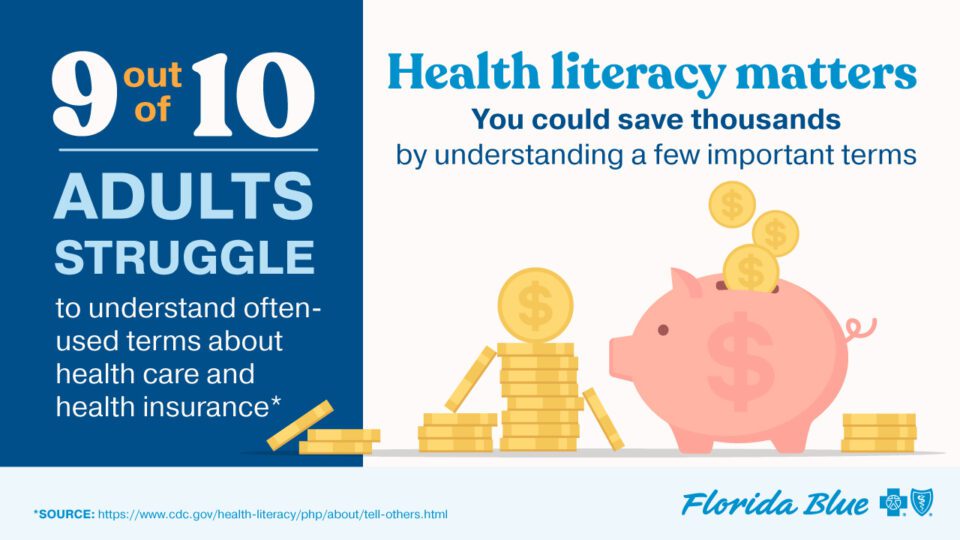
For many health care consumers, understanding how health care and health insurance benefits work feels like learning a foreign language. Nearly 9 out of 10 adults struggle to understand basic terms about health care and health insurance, according to the U.S. Centers for Disease Control and Prevention (CDC).1
Read more Everything in Between: Kiki Nunez with Guest Ashley Brosky, Serial Entrepreneur and Motherhood
The World Health Organization estimates that this “language barrier” can cost American adults between $143 to $7,798 more per year on health care,2 totaling up to $238 billion in unnecessary costs annually.3 It also can lead to skipped preventive care and unnecessaryhospital stays, the CDC report states.
Health care can be confusing and expensive – especially if you don’t understand where to get care and what your share of the cost is. You may have questions like: “What’s a copay?” or “What does being in-network really mean?” People who understand health and insurance terms are better able to make more informed decisions about their care, according to a 2025 article in the journal “Atencion Primaria.”4
Getting familiar with health insurance terms can help avoid surprise bills
“Health education is an important part of health coverage,” said David Wagner, market president, Florida Blue. “When people understand key health insurance terms and concepts, they are better prepared to make informed choices for their health and their budgets.”
Here are some of the most common health insurance terms people need to know:
- Premium: A premium is money you pay your insurance company regularly, usually monthly, to have your health insurance plan. Think of it like a membership fee – you’ll pay this amount to ensure you have coverage when you need it. This amount is due whether or not anyone on the plan used their benefits during the month.
o Those enrolled in a Marketplace plan may qualify for a premium tax credit or subsidy (financial help from the government), which may cover part or all of the monthly premium.*
o If you get your health insurance through your job, your premium is usually taken out of your paycheck automatically.
o If you have Medicare, most people choose to have their premium deducted automatically from their Social Security benefit payment.
- Network: Each insurance plan has a group (network) of doctors, hospitals, and pharmacies (providers) who agree to take care of people enrolled in the health insurance plan. The insurance company negotiates a discounted cost for health
care from these in-network providers.
- Allowed amount: This is the discounted rate a health plan’s member will pay when they receive care or prescription drugs from an in-network provider.
- Deductible: Most plans have an annual deductible – a set dollar amount you must pay toward the costs of your covered services before insurance starts to pay. Every dollar an individual spends on covered medical care or prescription drugs during the plan year goes toward this amount.
- Out-of-pocket maximum: This is the most a person will pay for covered services in a single year. Once what they’ve spent on covered medical care and prescription drugs adds up to this amount, the plan pays 100% of covered services for the rest of the year.
Health insurance helps offer peace of mind by ensuring there’s a limit to how much people will have to spend out of pocket for covered services each year. And getting familiar with the health insurance terms that define how much you’ll pay can help you avoid surprise bills this year.
Read more Kitchen 57 Fires Up National BBQ Day With a Limited-Time BBQ Menu in South Miami
“Florida Blue’s mission is to help communities and people achieve better health,” said Wagner. “We believe that starts with understanding how health insurance works. That’s why we’re committed to explaining these concepts in plain language and providing community resources to help people make informed decisions about their health care.”
Individuals can learn about key health care terms and how health insurance works by visiting visit FloridaBlue.com/health-insurance-education.
Sources:
1CDC: https://www.cdc.gov/health-literacy/php/about/tell-others.html
2World Health Organization: https://iris.who.int/server/api/core/bitstreams/f80ae253-f5a0-4e82-9c36-1db337f40114/content
3National Library of Medicine: https://pmc.ncbi.nlm.nih.gov/articles/PMC9465902/
4National Library of Medicine : https://pmc.ncbi.nlm.nih.gov/articles/PMC12296493
*If you qualify
About Florida Blue
Driven by its mission of helping people and communities achieve better health, Florida Blue is the leading health insurer in Florida, and part of GuideWell, a not-for-profit health services company. Florida Blue offers a range of health plans and personalized care programs for individuals, families, businesses of all sizes, and Medicare beneficiaries. For over 80 years, the organization has been member centric and committed to making health care as accessible and affordable as possible. Serving more than six million members across all 67 Florida counties, Florida Blue has more than 7,000 employees and is headquartered in Jacksonville, Fla., is owned by its policyholders, and is an independent licensee of the Blue Cross Blue Shield Association.
For additional information visit FloridaBlue.com.
For the latest news and content, visit the Florida Blue Newsroom, and follow Florida Blue on Facebook, LinkedIn, and Instagram @Florida.Blue; and X (formerly Twitter) @FLBlue.
Read more THE TOWN OF DAVIE HOSTS “READY DAVIE!” FAMILY FUN AND PUBLIC SAFETY EVENT ON JUNE 13, 2026