
By Steve Cody
Florida voters will soon be asked to decide a constitutional amendment that would dramatically reduce local property tax revenues.
Supporters call it tax relief.
Opponents warn it will devastate local governments.
Before Floridians cast their ballots, they should ask a simple question: If local governments lose billions of dollars, how are they supposed to continue providing the services residents expect?
The Legislature’s recently approved a constitutional amendment proposed by Governor Ron DeSantis that would significantly expand homestead exemptions from non-school property taxes. For homeowners frustrated by rising insurance costs, inflation, and the general cost of living, the proposal may sounds, on the surface, to be nearly irresistible.
But there is no such thing as a free tax cut.
Every dollar removed from local government budgets must either be replaced by another source of revenue or matched by a reduction in services.
The communities likely to feel the greatest impact are not necessarily Florida’s largest cities. They are often smaller municipalities that depend heavily on residential property taxes to fund their operations.
Consider two neighboring villages in the south part of the County: Pinecrest and Palmetto Bay.
Pinecrest has a smaller population than Palmetto Bay, but because of its higher home values it has traditionally enjoyed a larger property tax base and a much larger budget. Jerry Greenberg, a Pinecrest council member, has publicly expressed concern that the amendment threatens the qualities that make the Pinecrest attractive: beautiful parks, responsive services, and a high quality of life. Pinecrest lacks a heavy commercial real estate base that could pick up some of the real property tax slack.
Adoption of the amendment means Pinecrest will have to slash and burn through its budget.
Palmetto Bay faces similar concerns. Village projections indicate the proposed amendment could reduce local revenues by approximately $2.5 million in the first year and $4.3 million in the second year.
Those are not abstract numbers. Florida municipalities and counties face a shortfall of $4.6 billion in the first year and $8.4 billion in the second year after implementation. It will increase each year to keep pace with inflation.
Those dollars pay for police services, road maintenance, drainage improvements, parks and recreation programs, code enforcement, emergency preparedness, and countless other services residents rely upon every day.
When state leaders speak about reducing local property taxes, they rarely explain which of those services should be reduced.
Should police protection be cut?
Should parks receive less maintenance?
Should road projects be delayed?
Should stormwater improvements be postponed in a state increasingly vulnerable to flooding?
Read more FIU College of Medicine receives gift from Green Family Foundation to expand NeighborhoodHELP
Those are not rhetorical questions. They are the practical consequences that local elected officials will face if the amendment passes.
What makes this debate particularly striking is the timing.
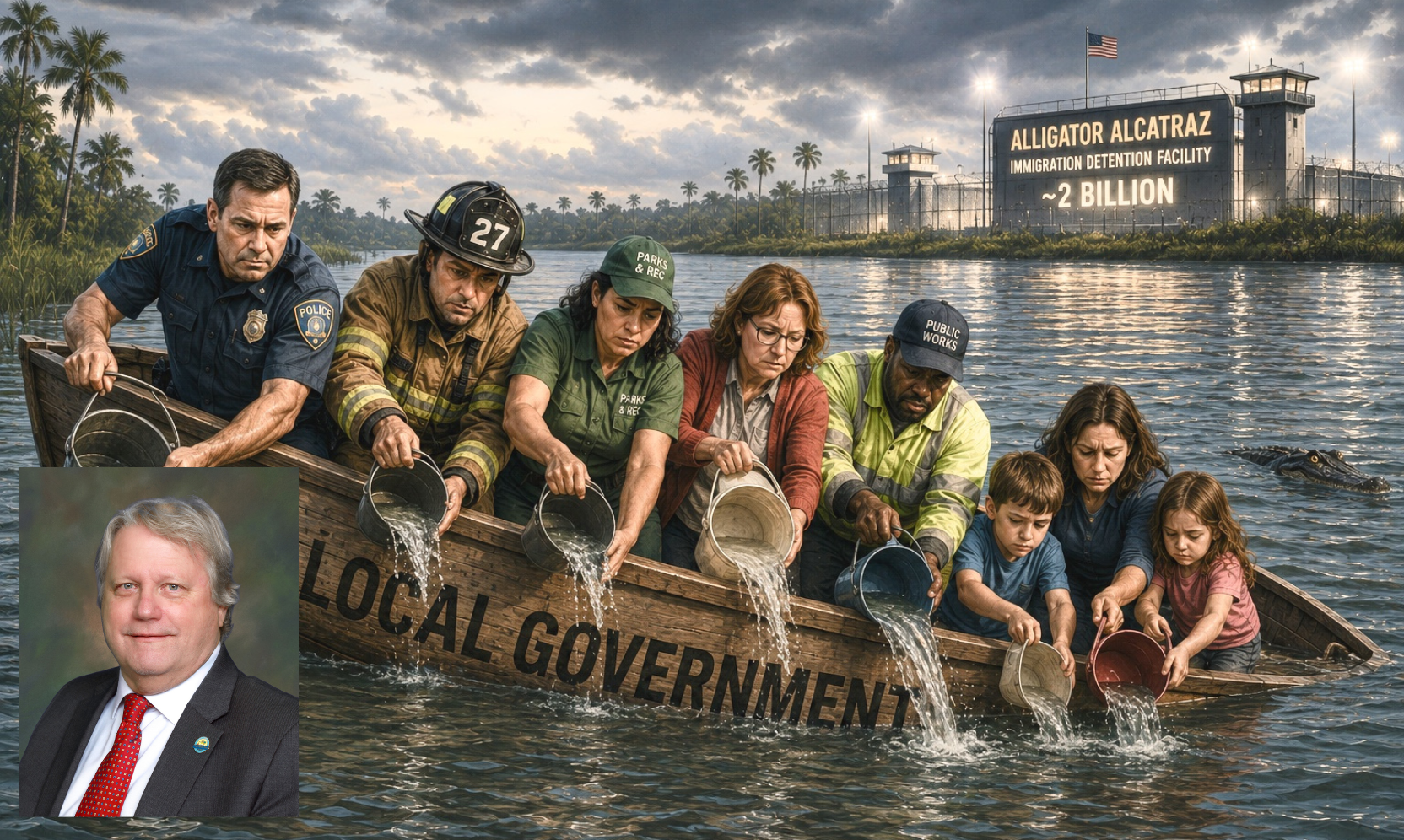
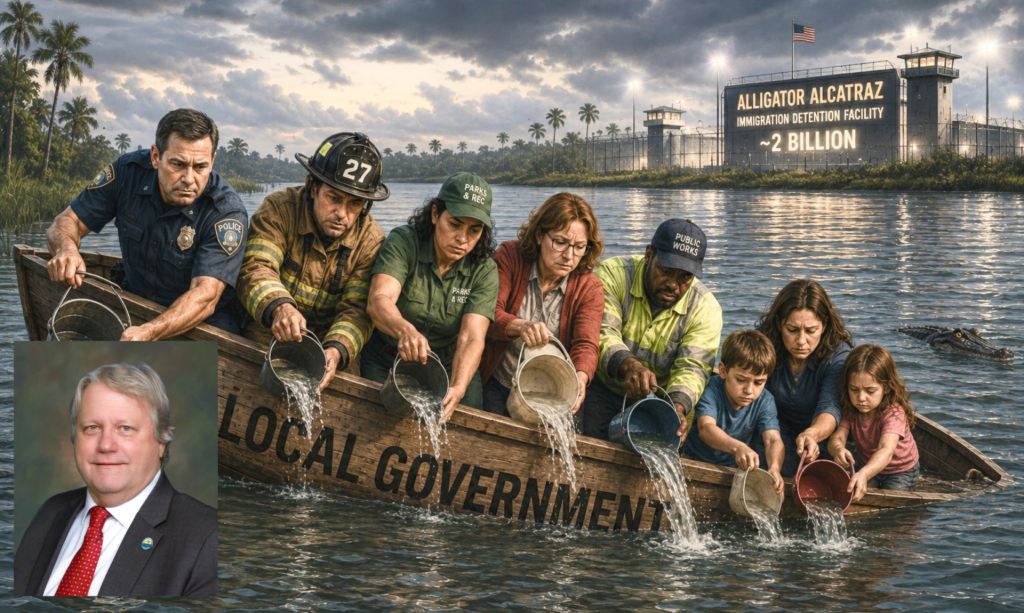
At the same moment state leaders are proposing to remove billions of dollars from local government revenue streams, Florida has spent or committed enormous sums to highly publicized immigration detention initiatives, including the facility popularly known as “Alligator Alcatraz.”
Reasonable people can disagree about immigration policy. That is not the issue.
The issue is priorities.
If Florida can find what will turn out to be billions of dollars for a detention facility in the Everglades, why can’t it identify a replacement funding source before proposing billions of dollars in local government tax reductions?
Why is the burden being shifted to cities, villages, counties, and special districts that are already responsible for delivering the services residents use every day?
Supporters of the amendment argue that local governments should simply learn to do more with less.
That is an appealing slogan.
It is also one that becomes more difficult to defend when residents begin noticing deteriorating parks, delayed infrastructure projects, and reduced public services.
The amendment’s supporters have every right to make their case. Tax relief is a legitimate policy goal.
But voters deserve an honest discussion.
If local governments lose billions in revenue, what exactly will replace those dollars?
If there is a plan, Floridians should hear it before they vote.
If there is no plan, then voters should be wary of what may become one of the most consequential local government funding decisions in Florida history.
Tax cuts are easy to promise.
Maintaining the services that make our communities desirable places to live is much harder.
Floridians deserve to know how both goals can be achieved before they are asked to choose.
Steve Cody is a Member of the Palmetto Bay Village Council who was first elected in 2020 and reelected in 2024.
Read more Let’s Make Miami-Dade No. 1